CNC Machining Services
Get world-class machining capabilities without the overhead of owning a factory. We support 1-piece minimum orders to meet your diverse custom prototyping and production needs.
Advantage: Fast delivery within 24 hours | Precision up to ±0.01 mm.
Get Instant Quote
CNC
Machining
3D
Printing
Printing
Sheet Metal
Fabrication
Injection
Molding
What Is CNC Machining
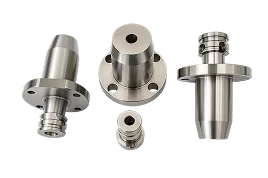
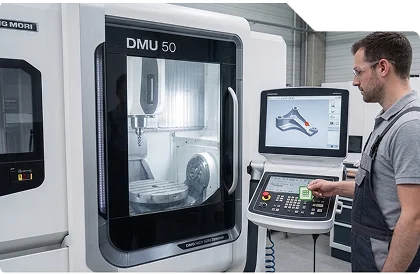
CNC machining (Computer Numerical Control machining) refers to the technology of automating the machining process by controlling machine tools through computer programs. CNC technology controls the movement of the machine tools by inputting numerical control programs, enabling high-precision part processing. Common types of CNC machining include milling, turning, drilling, grinding, and more.
In short, CNC machining achieves greater precision and stability through automation and precise control, while reducing human intervention and increasing production efficiency. It is widely applied in industries such as automotive, aerospace, mold-making, and electronics.
How CNC Machining Works
The working principle of CNC machining is simply to control the machine tool automatically to process parts using computer programs. The specific steps are as follows:
01
04
step 01
Program Writing
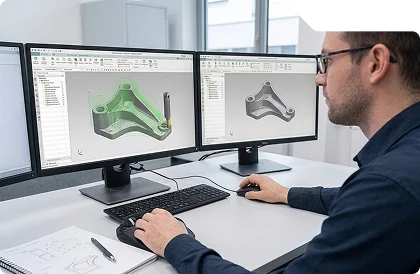
First, the designer uses CAD/CAM software to write the CNC program, determining the part's processing path, cutting parameters, and more.
step 02
Program Input
The written CNC program is then input into the CNC machine tool's control system.
step 03
Machine Executes Instructions
The CNC machine tool follows the program to control its movements, automatically adjusting the tool's position, speed, and feed rate, performing operations like milling, turning, and drilling.
step 04
Part Processing
The machine processes the part by precisely removing excess material step by step according to the set program.
Throughout the entire process, CNC technology ensures high precision, high efficiency, and reduces human intervention through automation control.
Features of CNC Machining
Advantages
Drawbacks
Fast and Consistent
Rapidly removes metal material, completing parts in one day with an efficient, stable process.
High Precision
Offers extremely high precision, with tolerances ranging from ±0.005” to ±0.01”, depending on customer specifications.
Diverse Material Options
Choose from over 50 different metals and plastics, providing a wide selection to meet various needs.
Advantages
Flexible Production Scale
CNC machining allows for scalable production, suitable for producing between 1 and 100,000 parts.
Tailored Surface Finishes
Suitable for various substrates, ensuring the surface finish of the parts matches the final product.
Cost-Effective
Low investment in tooling and preparation costs, making it economical for producing simple-structured parts.
Structural Limitations
Complex interlocking or hollow structures are difficult to process with CNC machining, and should be avoided.
Drawbacks
Scale Limitations
While CNC machining is efficient, the unit cost and lead time do not decrease as much as with injection molded parts.
CNC Main Classifications
CNC Milling
CNC Turning
CNC Milling
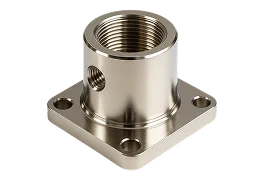
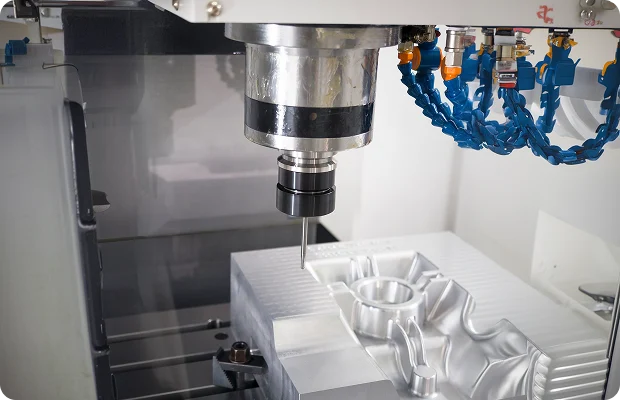
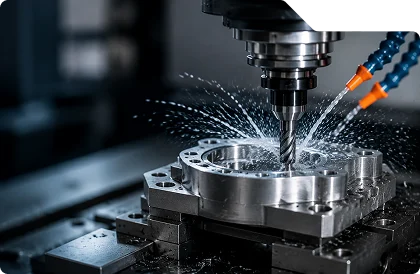
CNC milling is a machining method that removes material from a workpiece using a rotating multi-edge milling cutter. Milling is typically carried out on a three-axis or multi-axis machine tool, which controls the tool to cut along the X, Y, and Z axes. Milling is suitable for machining flat surfaces, curved surfaces, grooves, and other complex shapes, enabling high precision and complex surface machining.
Multi-axis Movement
Traditional CNC mills usually have three axes (X, Y, Z), but modern four-axis and five-axis CNC machines allow for more complex machining, improving flexibility and precision.
Rotating Tool
The cutting process is performed by a rotating milling cutter, which changes angles and positions to cut different surfaces and shapes.
Wide Range of Applications
Suitable for machining flat surfaces, grooves, holes, slanted surfaces, and more, especially for complex parts and high-precision workpieces.
Applications
Used in the aerospace, automotive, mold industries for machining complex parts.
Suitable for high-precision parts, complex contours, or curved surface machining.
CNC Turning
CNC turning is a machining method that removes material from a rotating workpiece using a stationary single-point cutting tool. Turning is typically performed on a lathe or turning machine, suitable for machining circular or symmetrical-shaped parts. The lathe performs linear movement along the X and Z axes to cut the external or internal surfaces of the workpiece, completing processes like external turning, internal hole machining, and threading.
Single-point Cutting
The cutting tool is typically single-edged, removing material from the rotating workpiece.
Suitable for Symmetrical Shapes
Turning is especially suitable for machining circular, shaft-like, or other symmetrical parts.
High Efficiency
Highly efficient for mass production, especially suitable for batch production of repetitive parts.
Applications
Used for producing shaft parts, gears, threads, valves, pipes, and other symmetrical parts.
Widely used in mass production for the automotive, machinery, and aerospace industries.
CNC Common materials
Loading materials…
Finishes
#1000 sanding
Anodized
Bead Blast
Bead Blast + Anodized Color
Black Oxide
Brushed
Chemical Conversion Coat (Chem Film)
Chrome Plating
Dyeing
Electrically conductive oxidation
Electrophoresis
Electropolished (Ra 0.8 µm 32 µin)
Etching
Galvanization
Gold Plating
Introduction to Passivation
Laser Engraving
Nickel Plating
Others
Pickling
Powder coat – Matt
Powder Coat – High Gloss
PVD (Physical Vapor Deposition)
Silkscreen
Silver Plating
Smooth machining (Ra1.6um, 63 µin)
Spray painting – High gloss paint
Spray painting – Matt paint
Standard (As-Milled) (Ra 125μin)
Tin Plating
Vacuum Plating – High Gloss Paint
Vacuum Plating – Matt Paint
Anodized
Bead Blast
Bead Blast + Anodized Color
Black Oxide
Brushed
Chemical Conversion Coat (Chem Film)
Chrome Plating
Dyeing
Electrically conductive oxidation
Electrophoresis
Electropolished (Ra 0.8 µm 32 µin)
Etching
Galvanization
Gold Plating
Introduction to Passivation
Laser Engraving
Nickel Plating
Others
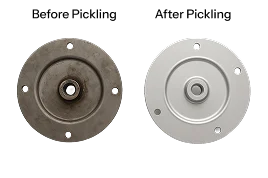
Pickling
Powder coat – Matt
Powder Coat – High Gloss
PVD (Physical Vapor Deposition)
Silkscreen
Silver Plating
Smooth machining (Ra1.6um, 63 µin)
Spray painting – High gloss paint
Spray painting – Matt paint
Standard (As-Milled) (Ra 125μin)
Tin Plating
Vacuum Plating – High Gloss Paint
Vacuum Plating – Matt Paint
Default Tolerances (For Drawings Without Specified Tolerances)
| Part Length | Dimensional Tolerance (Form & Orientation) | Angular Tolerance |
|---|---|---|
| 0 – 12 in (0 – 300 mm) | ±0.005" (0.125 mm) | ±0.5° |
| 12 – 24 in (300 – 600 mm) | ±0.010" (0.250 mm) | ±0.5° |
| 24 – 36 in (600 – 900 mm) | ±1/64" (0.016", 0.400 mm) | ±1° |
| 36 – 60 in (900 – 1500 mm) | ±1/32" (0.031") | ±1° |
| Over 60 in (>1500 mm) | ±1/16" (0.063") | ±1° |
Notes:
- Dimensional tolerances apply to all basic dimensions (length, width, diameter, etc.) as well as form and orientation features such as straightness, parallelism, and perpendicularity.
- Angular tolerances apply to all angles not specifically called out on the drawing.
- If specific tolerances are required, please clearly indicate them on the drawing. We will manufacture according to the specified values.
- The sharp edges will typically be chamfered with a radius of 0.004–0.012 inches by default. If sharp edges must be retained, please specify this clearly on the drawing.
- By default, fillets will be maintained at the intersections of internal corners, ruled surfaces, and curved surfaces.