

Injection Molding Services
Access hundreds of engineering-grade plastics combined with our rapid tooling technology to drastically shorten your time-to-market.
Advantage: Rapid tooling | Trusted by thousands of global clients.
Get Instant Quote
CNC
Machining
3D
Printing
Printing
Sheet Metal
Fabrication
Injection
Molding
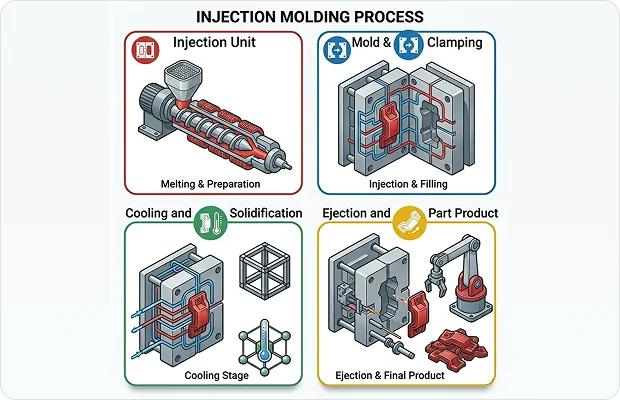
What Is Injection Molding?
Injection Molding is a manufacturing process commonly used for producing parts from plastics, metals, rubber, and other materials. It involves injecting molten material into a closed mold, which then cools and solidifies to form the desired part. This process is carried out using an injection molding machine and is particularly suited for high-volume production, making it ideal for manufacturing products that require high precision and complex shapes.
How Injection Molding Works
Heating and Melting:
The raw material (usually plastic pellets) is placed into the heating zone of the injection molding machine, where it is heated and melted into liquid plastic by the screw.
Injection into the Mold:
The molten plastic is injected under high pressure into a closed mold, filling all the details of the mold to ensure that every part is completely filled.
Cooling and Solidifying:
The plastic cools and solidifies inside the mold, forming a solid part. This process is typically assisted by cooling channels within the mold.
Mold Opening and Ejection:
After cooling, the mold is opened, and the solidified part is ejected, completing the molding process.
Finishing and Inspection:
The molded parts may require removal of burrs or other surface treatments, and quality checks are performed to ensure the product meets the required standards.
Features of CNC Machining
Advantages
Drawbacks
Wide Material Selection:
Offers dozens of engineering plastics and high-performance materials, including ABS, PC, PA, POM, and PEEK.Supports the addition of functional modifiers such as glass fibers, flame retardants, and UV stabilizers to meet various strength, toughness, and environmental requirements.
Flexible Production Capability:
Can seamlessly shift between single prototypes, small-batch trials, and large-scale production based on customer needs — ideal for rapid design validation or stable long-term supply.Production capacity can be expanded to over 500,000 parts, suitable for diverse industry applications.
High Efficiency and Fast Delivery:
Mold fabrication can be completed in as little as 15 days, with a highly automated molding process. Depending on part complexity and quantity, delivery can be achieved within 1–15 days, significantly shortening time-to-market.
Wide Range of Applications
Extensively used in consumer electronics, automotive components, medical devices, industrial equipment, and household appliances — fulfilling both functional and aesthetic demands across industries.
Advantages
Excellent Surface Quality and Appearance:
Molds can be finely polished or textured to achieve glossy, matte, leather-grain, or etched finishes.Additional post-processing such as painting, electroplating, silk-screen printing, or laser engraving can be applied to meet both aesthetic and functional requirements.
Cost Efficiency:
For medium- and large-scale production, the per-unit cost is low, molds can be reused, and overall manufacturing expenses are more economical than CNC machining or 3D printing.
Durable and Stable Products:
Molded parts feature dense structure and excellent mechanical properties, with good wear resistance, heat resistance, and dimensional stability — suitable for long-term applications.
High Precision and Consistency:
Utilizes precision CNC-machined molds and standardized molding parameters, ensuring dimensional accuracy and strong consistency — ideal for mass production of functional and structural components.
Limited Structural Complexity
Parts with deep cavities, internal threads, closed hollows, or complex interlocking structures may be difficult to form in one process, requiring segmentation, inserts, or post-assembly.
High Initial Investment
Mold design and manufacturing entail high upfront costs. For small batches or multiple design variants, cost amortization is less favorable compared with CNC machining or 3D printing.
Drawbacks
High Design Modification Cost:
Once molds are finalized, design changes require mold rework or remanufacturing, increasing both lead time and cost.
Injection Molding Processes
General Thermoplastics
Engineering Plastics
High-Performance &
Specialty Materials
Blends & Composite Plastics
Elastomers & Rubbers
Foamed Plastics
| Material | Key Properties |
|---|---|
| Polypropylene (PP) | Lightweight, strong chemical resistance, excellent electrical insulation. |
| Polyethylene (PE, including HDPE and LDPE) | Good flexibility, wear-resistant, impact-resistant. |
| Polystyrene (PS) | Excellent moldability, high transparency, good rigidity. |
| Polyvinyl Chloride (PVC) | Corrosion-resistant, flame-retardant, can be rigid or flexible. |
| Acrylonitrile-Butadiene-Styrene (ABS) | High strength, good toughness, glossy surface finish. |
| Acrylonitrile-Styrene-Acrylate (ASA) | UV-resistant, weatherability better than ABS. |
Note: Low cost, good processability, suitable for mass production.
| Material | Key Properties |
|---|---|
| Polypropylene (PP) | Lightweight, strong chemical resistance, excellent electrical insulation. |
| Polyethylene (PE, including HDPE and LDPE) | Good flexibility, wear-resistant, impact-resistant. |
| Polystyrene (PS) | Excellent moldability, high transparency, good rigidity. |
| Polyvinyl Chloride (PVC) | Corrosion-resistant, flame-retardant, can be rigid or flexible. |
| Acrylonitrile-Butadiene-Styrene (ABS) | High strength, good toughness, glossy surface finish. |
| Acrylonitrile-Styrene-Acrylate (ASA) | UV-resistant, weatherability better than ABS. |
| Polycarbonate (PC) | High transparency, strong impact resistance. |
| Polyoxymethylene (POM) | High strength, wear-resistant, dimensionally stable. |
| Polyamide (PA6/66/12, Nylon) | High toughness, wear-resistant, fatigue-resistant. |
| Polybutylene Terephthalate (PBT) | Excellent electrical insulation, good chemical resistance. |
| Polyethylene Terephthalate (PET) | High strength, excellent heat resistance, low water absorption. |
| Polymethyl Methacrylate (PMMA) | High transparency, good weather resistance, hard surface. |
| Polycyclohexylene Dimethylene Terephthalate (PCT) | Excellent high-temperature performance, dimensionally stable. |
| Polyphthalamide (PPA) | High strength, heat-resistant. |
| Polyether Ether Ketone (PEEK) | Ultra-high heat resistance, excellent chemical stability. |
| Polyether Imide (PEI) | Maintains excellent strength at high temperatures. |
| Polyamide Imide (PAI) | Extremely heat-resistant, good dimensional accuracy. |
| Polyimide (PI) | Can operate continuously at high temperatures. |
| Polyphenylene Sulfide (PPS) | Self-lubricating, chemical resistant, high temperature resistant. |
| Polyvinylidene Fluoride (PVDF) | Corrosion-resistant, strong weatherability. |
| Polytetrafluoroethylene (PTFE) | Extremely low friction, high heat resistance, exceptional chemical resistance. |
Note: Excellent mechanical performance, high heat resistance, dimensional stability; suitable for structural and industrial components.
| Material | Key Properties |
|---|---|
| Polylactic Acid (PLA) | Biodegradable and eco-friendly, commonly used for 3D printing and disposable products. |
| Ultra-High Molecular Weight Polyethylene (UPE/UHMW) | Extremely wear-resistant, low friction coefficient. |
| Copolyester (COPO) | Good toughness, high transparency, food-grade applications. |
| Cellulose Acetate (CA) | Eco-friendly, bio-based, high transparency. |
Note: Functional or eco-friendly, often used for high-demand applications.
| Material | Key Properties |
|---|---|
| PC+ABS Blend | High strength, good appearance, commonly used in electronic housings. |
| PC+PBT Blend | Heat-resistant, impact-resistant, dimensionally stable; used for automotive parts. |
| PC+PET Blend | High strength and chemical resistance. |
| PS+PPE Blend | Good electrical insulation, dimensionally stable. |
| PE+PS Blend | Impact-resistant, stable in molding and processing. |
| PE+PP Blend | High toughness, low density. |
| PBT+PET Blend | High strength, excellent heat resistance. |
Note: Combines advantages of multiple plastics to achieve balanced performance.
| Material | Key Properties |
|---|---|
| Thermoplastic Elastomer (TPE) | Soft to touch, recyclable, easy to process. |
| Thermoplastic Polyurethane (TPU) | Wear-resistant, tear-resistant, good elasticity. |
| Liquid Silicone Rubber (LSR) | Resistant to high and low temperatures, biocompatible. |
| Polyolefin Elastomer (POE) | Soft, good low-temperature flexibility. |
| Ethylene Propylene Diene Monomer (EPDM) | Weather-resistant, aging-resistant, ozone-resistant. |
| Melt Processable Rubber (MPR) | Heat-processable rubber material. |
| Soft PVC (Flexible PVC) | Soft PVC, used for sheathing and sealing. |
Note: Soft and elastic, commonly used for sealing, vibration damping, and coatings.
| Material | Key Properties |
|---|---|
| EVA Foam | Soft, elastic, excellent shock absorption. |
| EPS Foam | Lightweight, thermal insulation, impact-resistant. |
| PU Foam | Elastic, sound-absorbing, comfortable. |
Note: Lightweight, offers cushioning, energy absorption, or thermal insulation.
Plastic Injection Molding
Process Principle:
This is the most common and widely used injection molding technique. The process involves heating thermoplastic polymer granules — materials that can be repeatedly melted and solidified — inside the barrel of an injection molding machine until they become molten. The molten plastic is then injected under high pressure by a screw into a closed mold cavity. After cooling and solidifying within the mold, the mold opens, and the formed part is ejected.
Material:
Uses thermoplastic materials such as ABS, Polypropylene (PP), and Polycarbonate (PC), offering an extremely wide selection.
Applications:
Covers nearly all daily and industrial sectors, including electronic housings, automotive components, and consumer products.
Advantages:
Enables large-scale production, provides excellent cost efficiency, achieves high replication accuracy, and delivers superior surface detail.
Liquid Silicone Rubber (LSR) Molding
Process Principle:
This is a thermosetting molding process. Liquid silicone rubber typically consists of two components: Part A (base compound) and Part B (curing agent). Before molding, the two components are precisely mixed and injected into a heated mold via a metering injection system. Under the catalytic effect of platinum and heat, the LSR undergoes a cross-linking (curing) reaction, transforming from a linear structure into a stable three-dimensional network to form an elastic product.
Material:
Uses liquid silicone rubber, a high-performance elastomer.
Performance:
Excellent biocompatibility
Outstanding resistance to extreme temperatures (-60°C to above 200°C)
Soft and elastic texture
High transparency and chemical inertness
Advantages:
Commonly used in medical devices (respiratory masks, valves), baby products (nipples), kitchenware (baking molds), and sealing components where high performance is required.
Overmolding & Insert Molding
Process Principle:
This is an advanced multi-material or multi-componentl injection molding process, generally carried out in two steps:
01
Step One: A rigid base component (substrate, usually plastic) is molded, or a metal insert (such as a threaded sleeve or electrode) is positioned.
02
Step Two: The substrate or insert is placed into a second mold, where a second material (typically a soft elastomer such as TPU or LSR) is injected to firmly encapsulate or bond with it, forming a single, integrated functional component.
Function:
Integrates different materials and functionalities — for example, adding a soft-touch layer for grip and comfort on a rigid handle, or embedding metal parts within plastic to enhance strength or performance.
Advantages:
Reduces assembly processes
Improves product reliability
Enables complex, multifunctional designs
Typical Applications:
Include two-color anti-slip tool handles, mobile phone cases, toothbrushes with soft grips, and connectors with integrated sealing rings.