

CNC Machining Services
Get world-class machining capabilities without the overhead of owning a factory. We support 1-piece minimum orders to meet your diverse custom prototyping and production needs.
Advantage: Fast delivery within 24 hours | Precision up to ±0.01 mm.
Get Instant Quote
CNC
Machining
3D
Printing
Printing
Sheet Metal
Fabrication
Injection
Molding
CNC Turning Overview
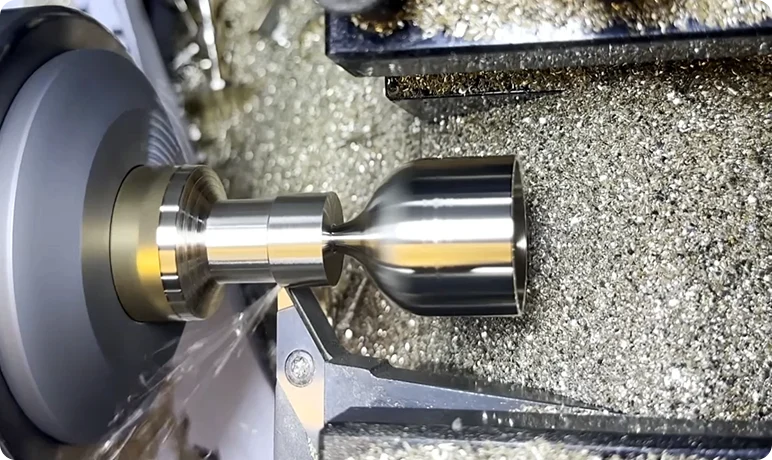
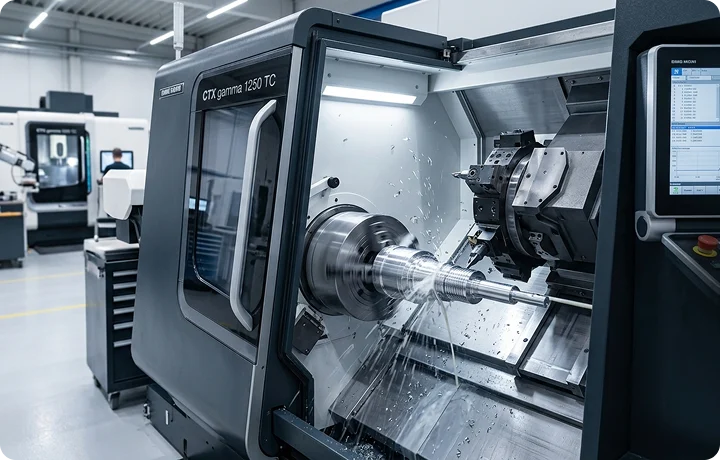
CNC turning is a precision machining process that uses a computer numerical control (CNC) system to control the motion of a machine tool.
It involves rotating the workpiece while a fixed cutting tool removes material to create symmetrical parts with high precision.
This process is widely used in industries such as machinery, automotive, and aerospace.
Working Principle of CNC Turning:
Material Removal:
The cutting tool moves along the surface of the rotating workpiece, removing excess material to form the desired shape.
Precision Control:
The CNC system precisely controls the movement of the tool, ensuring the production of complex geometric shapes and high-precision parts.
Automation and High Repetition:
CNC lathes can automatically perform multiple operations, ensuring consistency in mass production.
Applications of CNC Turning
Symmetrical Part Manufacturing
Used for the production of parts with symmetrical shapes such as shafts, discs, gears, etc.
High-Precision Part Manufacturing
Suitable for parts that require strict tolerances and smooth surface finishes, such as precision machinery and automotive components.
Material Versatility
Suitable for machining a variety of materials including metals, plastics, and alloys.
Types of CNC Turning
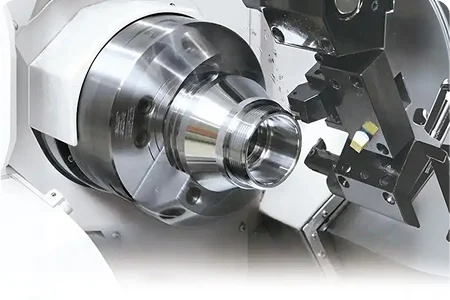
Standard CNC Turning
Suitable for parts with simple geometric shapes, such as shafts and discs.
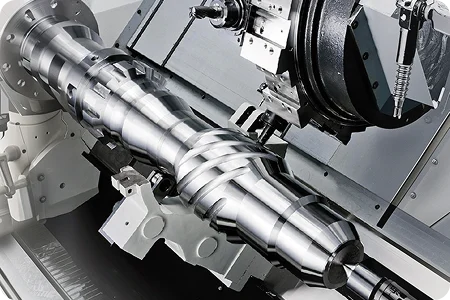
Advanced CNC Turning
Includes operations such as drilling, threading, grooving, etc., and is used for more complex machining needs.
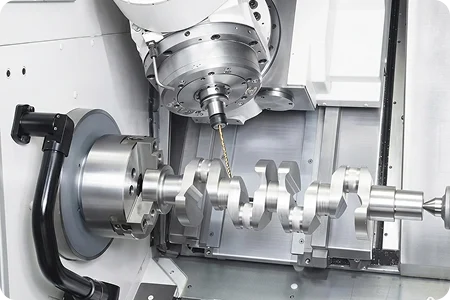
Multi-Axis CNC Turning
Capable of machining complex curved surfaces, suitable for the production of highly intricate parts.
Advantages of CNC Milling
High Precision
Can achieve micron-level tolerance requirements.
High Efficiency
Automated machining improves production efficiency, making it ideal for mass production.
Multifunctionality
In addition to turning, it can perform drilling, milling, and other machining operations.
Wide Applicability
Suitable for different materials, particularly beneficial in precision machining fields.
Features of CNC Machining
Advantages
Drawbacks
Rapid Response
With an efficient CNC machining system, CNCFAST can complete production and delivery in an extremely short cycle — as fast as 2 days. We provide quick and reliable machining solutions to help you accelerate project timelines.
High Precision Manufacturing
We maintain strict dimensional accuracy, typically within a tolerance range of ±0.001”–0.005”. CNCFAST specializes in high-precision component production, ensuring every detail meets the design specifications.
Flexible Production Scalability
From prototypes and small-batch trials to full-scale mass production, CNCFAST adapts flexibly to different manufacturing stages. Our monthly output can reach hundreds of thousands of precision parts.
Advantages
Wide Range of Materials
Over 50 types of metals and engineering plastics are available — including aluminum, stainless steel, copper, POM, nylon, and PEEK — to meet various structural and performance requirements.
Customized Surface Finishes
A variety of surface treatments are available, such as bead blasting, anodizing, electroplating, polishing, and coating, ensuring that your parts achieve both the desired functionality and final appearance.
Cost Efficiency
With no need for expensive molds or tooling, CNCFAST offers a highly economical solution for low- to medium-volume production and product development stages, helping customers reduce overall manufacturing costs.
Structural Complexity
Deep cavities, undercuts, or parts with complex internal geometries may be challenging for CNC machining and may require design optimization or multiple setups.
Drawbacks
Cost and Scale Effect
Compared to injection molding, CNC machining typically has a higher unit cost for large-volume production, making it more suitable for small-batch or customized manufacturing needs.
CNC Machining Materials
Metals
Plastics
| Material | Description |
|---|---|
| Aluminum | Lightweight, excellent thermal and electrical conductivity; ideal for structural and appearance parts. |
| Stainless Steel | Corrosion-resistant, strong, and smooth in appearance; used for mechanical structures and housings. |
| Brass | Good machinability with excellent electrical and thermal conductivity; used for decorative and electrical components. |
| Copper | Exceptional electrical and thermal conductivity; suitable for connectors and heat dissipation parts. |
| Titanium | Lightweight, high strength, and corrosion-resistant; ideal for high-end precision components. |
| Mild Steel | Moderate strength, low cost, and good machinability; commonly used for structural parts. |
| Alloy Steel | Excellent mechanical properties and wear resistance; suitable for load-bearing and transmission components. |
| Tool Steel | High hardness and wear resistance; used for molds, cutting tools, and dies. |
| Spring Steel | High elasticity and fatigue strength; used for springs, clips, and resilient components. |
| Material | Description |
|---|---|
| ABS | Strong, tough, and easy to machine; commonly used for housings and structural parts. |
| Polycarbonate (PC) | Transparent and impact-resistant; ideal for guards, covers, and clear parts. |
| Nylon | High strength, wear-resistant, and self-lubricating; used for gears and sliding components. |
| Polypropylene (PP) | Lightweight and chemically resistant; used for containers and mechanical parts. |
| POM | High stiffness and dimensional stability; ideal for precision gears and bearings. |
| PTFE (Teflon) | Excellent heat and chemical resistance with low friction; used for seals and liners. |
| PMMA (Acrylic) | High transparency and visual appeal; used for displays and light covers. |
| Polyethylene (PE) | Impact-resistant and low-temperature durable; used for protective and cushioning components. |
| PEEK | High-performance polymer with excellent strength, temperature, and chemical resistance; for advanced engineering parts. |
| Bakelite | Hard, insulating, and heat-resistant; used for electrical insulation components. |
| FR4 | Heat-resistant and electrically insulating; commonly used for circuit boards and support structures. |
| Carbon Fiber | Lightweight with exceptional strength and rigidity; used in aerospace, racing, and precision machinery. |
Finishes
Common Finishes for Aluminum
Common Finishes for Steel
| Process Name | Description | Typical Color |
|---|---|---|
| Anodized | Forms a dense oxide layer on the aluminum surface through electrolysis, enhancing corrosion resistance, hardness, and wear resistance. Can be colored or left in natural metal color. Suitable for structural parts, decorative components, and electronic housings. | Silver, Black, Gold, Red, Blue, etc. (can be adjusted by dyeing) |
| Electrically Conductive Oxidation | Special electrochemical treatment creates a thin conductive oxide layer, maintaining aluminum conductivity while improving corrosion resistance. Commonly used in electronic structural parts, connectors, or heat dissipation components. | Silver-gray or natural aluminum color |
| Bead Blast + Anodized Color | First bead blasted to create a uniform matte surface, then anodized and colored. Aesthetic, corrosion-resistant, with a matte finish and smooth touch. Suitable for high-end appearance parts. | Matte silver, matte black, matte gold, other custom colors |
| Bead Blast | High-speed sand particles impact the aluminum surface to form a uniform matte texture, improving feel or providing a base for subsequent anodizing. Suitable for decorative and industrial parts. | Matte silver or natural aluminum color |
| Brushed | Sandpaper or wire wheels create elongated texture in one direction, forming a decorative metal surface with comfortable touch. Suitable for panels and decorative components. | Silver, gray, gold, etc. |
| Process Name | Description | Typical Color |
|---|---|---|
| Nickel Plating | Plating a layer of nickel on steel improves corrosion resistance and wear resistance. Surface is smooth and bright, providing decorative effect. Suitable for hardware parts, molds, and electronic components. | Silver-white, gray-white |
| Galvanization | Zinc layer is formed via electroplating or hot-dip galvanizing. Common anti-corrosion process for steel parts. Resistant to humid and hot environments. Suitable for structural parts and bolts. | Silver-gray, matte gray |
| Chrome Plating | Chrome layer on steel surface provides high hardness, wear resistance, and mirror brightness. Commonly used for decorative parts, tools, and molds. | Mirror silver, high-gloss silver |
| Black Oxide | Forms a thin black oxide layer on steel surface, preventing rust and reducing reflection. Suitable for hardware and mechanical parts. | Black or dark gray |
Default Tolerances (For Drawings Without Specified Tolerances)
| Part Length | Dimensional Tolerance (Form & Orientation) | Angular Tolerance |
|---|---|---|
| 0 – 12 in (0 – 300 mm) | ±0.005" (0.125 mm) | ±0.5° |
| 12 – 24 in (300 – 600 mm) | ±0.010" (0.250 mm) | ±0.5° |
| 24 – 36 in (600 – 900 mm) | ±1/64" (0.016", 0.400 mm) | ±1° |
| 36 – 60 in (900 – 1500 mm) | ±1/32" (0.031") | ±1° |
| Over 60 in (>1500 mm) | ±1/16" (0.063") | ±1° |
Notes:
- Dimensional tolerances apply to all basic dimensions (length, width, diameter, etc.) as well as form and orientation features such as straightness, parallelism, and perpendicularity.
- Angular tolerances apply to all angles not specifically called out on the drawing.
- If specific tolerances are required, please clearly indicate them on the drawing. We will manufacture according to the specified values.
- The sharp edges will typically be chamfered with a radius of 0.004–0.012 inches by default. If sharp edges must be retained, please specify this clearly on the drawing.
- By default, fillets will be maintained at the intersections of internal corners, ruled surfaces, and curved surfaces.