Get world-class machining capabilities without the overhead of owning a factory. We support 1-piece minimum orders to meet your diverse custom prototyping and production needs.
Advantage: Fast delivery within 24 hours | Precision up to ±0.01 mm.
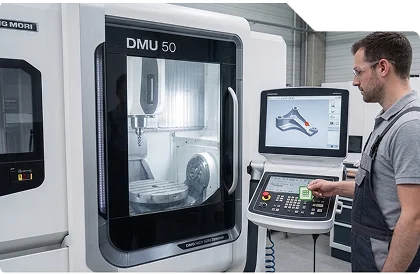
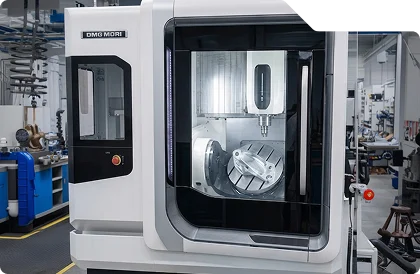
CNC machining (Computer Numerical Control machining) refers to the technology of automating the machining process by controlling machine tools through computer programs. CNC technology controls the movement of the machine tools by inputting numerical control programs, enabling high-precision part processing. Common types of CNC machining include milling, turning, drilling, grinding, and more.
In short, CNC machining achieves greater precision and stability through automation and precise control, while reducing human intervention and increasing production efficiency. It is widely applied in industries such as automotive, aerospace, mold-making, and electronics.
How CNC Machining Works
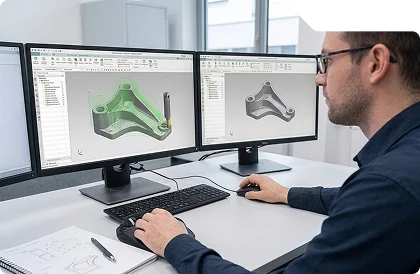
The working principle of CNC machining is simply to control the machine tool automatically to process parts using computer programs. The specific steps are as follows:
01
04
step 01
Program Writing
First, the designer uses CAD/CAM software to write the CNC program, determining the part's processing path, cutting parameters, and more.
step 02
Program Input
First, the designer uses CAD/CAM software to write the CNC program, determining the part's processing path, cutting parameters, and more.
step 03
Machine Executes Instructions
First, the designer uses CAD/CAM software to write the CNC program, determining the part's processing path, cutting parameters, and more.
step 04
Program Writing
First, the designer uses CAD/CAM software to write the CNC program, determining the part's processing path, cutting parameters, and more.
Features of CNC Machining
Advantages
Drawbacks
Fast and Consistent
Rapidly removes metal material, completing parts in one day with an efficient, stable process.
High Precision
Offers extremely high precision, with tolerances ranging from ±0.005” to ±0.01”, depending on customer specifications.
Diverse Material Options
Choose from over 50 different metals and plastics, providing a wide selection to meet various needs.
Advantages
Flexible Production Scale
CNC machining allows for scalable production, suitable for producing between 1 and 100,000 parts.
Tailored Surface Finishes
Suitable for various substrates, ensuring the surface finish of the parts matches the final product.
Cost-Effective
Low investment in tooling and preparation costs, making it economical for producing simple-structured parts.
Fast and Consistent
Rapidly removes metal material, completing parts in one day with an efficient, stable process.
High Precision
Offers extremely high precision, with tolerances ranging from ±0.005” to ±0.01”, depending on customer specifications.
Diverse Material Options
Choose from over 50 different metals and plastics, providing a wide selection to meet various needs.
Drawbacks
Flexible Production Scale
CNC machining allows for scalable production, suitable for producing between 1 and 100,000 parts.
Tailored Surface Finishes
Suitable for various substrates, ensuring the surface finish of the parts matches the final product.
Cost-Effective
Low investment in tooling and preparation costs, making it economical for producing simple-structured parts.
CNC Main Classifications
CNC Milling
CNC Turning
CNC Milling
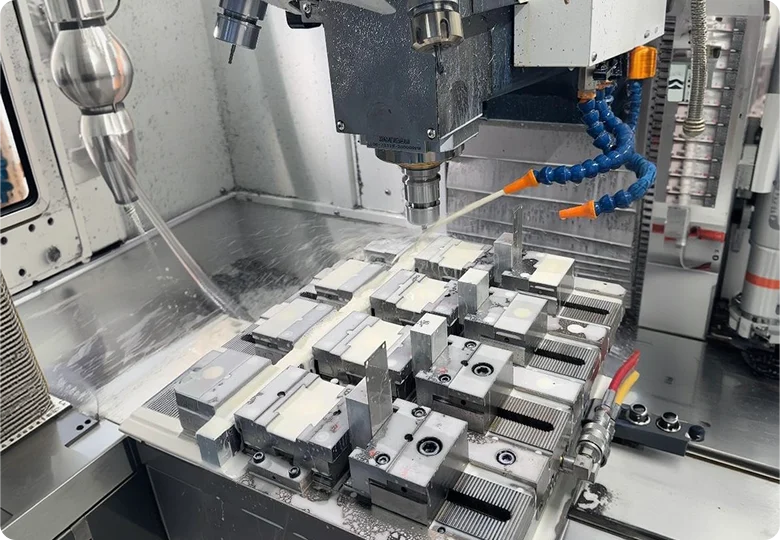
CNC milling is a machining method that removes material from a workpiece using a rotating multi-edge milling cutter. Milling is typically carried out on a three-axis or multi-axis machine tool, which controls the tool to cut along the X, Y, and Z axes. Milling is suitable for machining flat surfaces, curved surfaces, grooves, and other complex shapes, enabling high precision and complex surface machining.
Multi-axis Movement
CNC milling is a machining method that removes material from a workpiece using a rotating multi-edge milling cutter. Milling is typically carried out on a three-axis or multi-axis machine tool, which controls the tool to cut along the X, Y, and Z axes. Milling is suitable for machining flat surfaces, curved surfaces, grooves, and other complex shapes, enabling high precision and complex surface machining.
Rotating Tool
CNC milling is a machining method that removes material from a workpiece using a rotating multi-edge milling cutter. Milling is typically carried out on a three-axis or multi-axis machine tool, which controls the tool to cut along the X, Y, and Z axes. Milling is suitable for machining flat surfaces, curved surfaces, grooves, and other complex shapes, enabling high precision and complex surface machining.
Wide Range of Applications
CNC milling is a machining method that removes material from a workpiece using a rotating multi-edge milling cutter. Milling is typically carried out on a three-axis or multi-axis machine tool, which controls the tool to cut along the X, Y, and Z axes. Milling is suitable for machining flat surfaces, curved surfaces, grooves, and other complex shapes, enabling high precision and complex surface machining.
Applications
CNC milling is a machining method that removes material from a workpiece using a rotating multi-edge milling cutter. Milling is typically carried out on a three-axis or multi-axis machine tool, which controls the tool to cut along the X, Y, and Z axes. Milling is suitable for machining flat surfaces, curved surfaces, grooves, and other complex shapes, enabling high precision and complex surface machining.
CNC Milling
CNC milling is a machining method that removes material from a workpiece using a rotating multi-edge milling cutter. Milling is typically carried out on a three-axis or multi-axis machine tool, which controls the tool to cut along the X, Y, and Z axes. Milling is suitable for machining flat surfaces, curved surfaces, grooves, and other complex shapes, enabling high precision and complex surface machining.
Multi-axis Movement
CNC milling is a machining method that removes material from a workpiece using a rotating multi-edge milling cutter. Milling is typically carried out on a three-axis or multi-axis machine tool, which controls the tool to cut along the X, Y, and Z axes. Milling is suitable for machining flat surfaces, curved surfaces, grooves, and other complex shapes, enabling high precision and complex surface machining.
Rotating Tool
CNC milling is a machining method that removes material from a workpiece using a rotating multi-edge milling cutter. Milling is typically carried out on a three-axis or multi-axis machine tool, which controls the tool to cut along the X, Y, and Z axes. Milling is suitable for machining flat surfaces, curved surfaces, grooves, and other complex shapes, enabling high precision and complex surface machining.
Wide Range of Applications
CNC milling is a machining method that removes material from a workpiece using a rotating multi-edge milling cutter. Milling is typically carried out on a three-axis or multi-axis machine tool, which controls the tool to cut along the X, Y, and Z axes. Milling is suitable for machining flat surfaces, curved surfaces, grooves, and other complex shapes, enabling high precision and complex surface machining.
Applications
CNC milling is a machining method that removes material from a workpiece using a rotating multi-edge milling cutter. Milling is typically carried out on a three-axis or multi-axis machine tool, which controls the tool to cut along the X, Y, and Z axes. Milling is suitable for machining flat surfaces, curved surfaces, grooves, and other complex shapes, enabling high precision and complex surface machining.